Standalone/Deep Learning
Introduction to Deep Learning: The Heart of Artificial Intelligence
Aug 29, 2024·13 min read
Deep learning is a branch of Artificial Intelligence (AI) and Machine Learning (ML) that mimics the way the human brain works. It uses a structure called a “Neural Network” to process data and make decisions or predictions. Unlike traditional machine learning, which often relies on statistical methods, DL is more about building a logical structure inspired by the brain’s network of neurons.
In simple terms, deep learning algorithms try to think like humans by continuously analyzing data and learning from it. There are various types of neural networks used in deep learning, such as Artificial Neural Networks (ANN), Convolutional Neural Networks (CNN), Recurrent Neural Networks (RNN), and Generative Adversarial Networks (GANs). Each type of network has its own specific purpose and structure. Here is a short description of each type of neural network:
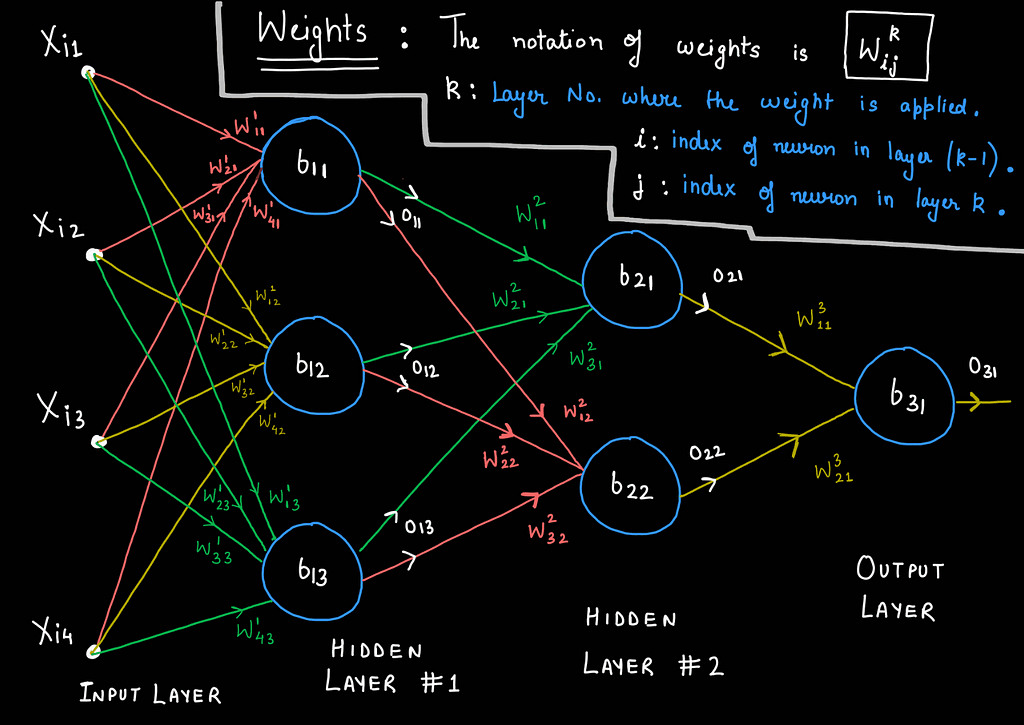
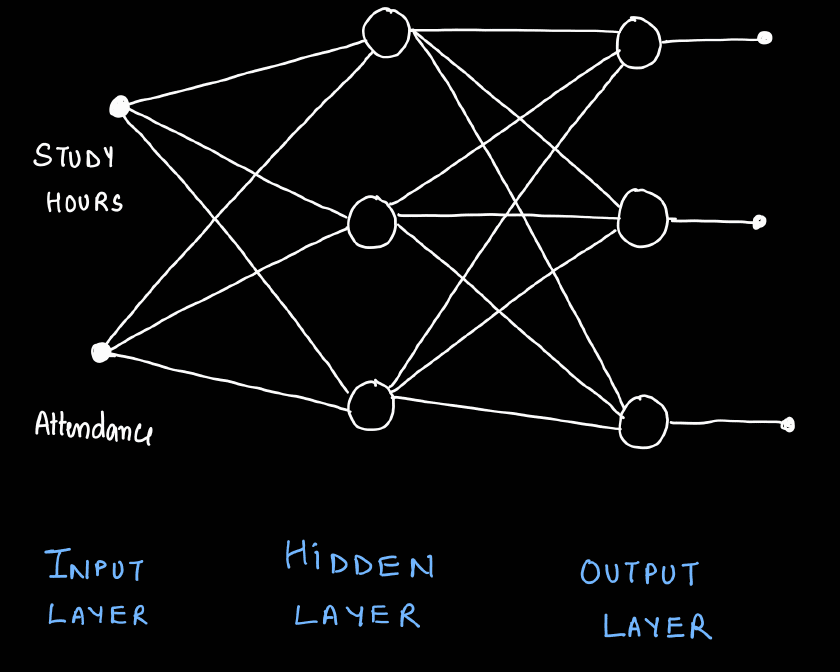
Artificial Neural Networks (ANN): ANNs are the simplest form of neural networks, consisting of input, hidden, and output layers. They are used for general tasks like classification and regression by learning patterns in data through connected layers of neurons.
Convolutional Neural Networks (CNN): CNNs are specialized for image processing and pattern recognition tasks. They use convolutional layers to detect features like edges and textures in images, making them ideal for tasks like image classification and object detection.
Recurrent Neural Networks (RNN): RNNs are designed to process sequential data by maintaining a memory of previous inputs. They are used in tasks where the order of data points matters, such as natural language processing, speech recognition, and time series prediction.
Generative Adversarial Networks (GANs): GANs consist of two networks — a Generator and a Discriminator — that work together to generate realistic data from random noise. They are used for tasks like image generation, data augmentation, and style transfer.
More technical definition of Deep Learning
Deep learning is part of a broader family of machine learning methods based on artificial neural networks with representation learning. But what is representation learning? Representation learning, in simple words, is when a computer learns to identify and understand important features or patterns in data on its own. Instead of us telling the computer exactly what to look for, the computer figures out by itself what details matter the most.
For example, if a computer is learning to recognize pictures of dogs, it might first learn to notice basic shapes and colors. As it gets better, it starts recognizing specific features like fur, ears, or tails. Eventually, it can look at a picture and know it’s a dog without any help from us. This process of automatically finding and understanding useful details from the data is what we call representation learning. Representation learning is a key part of deep learning, where the computer automatically learns to find important details in data through multiple layers. Each layer builds on the last, gradually understanding more complex patterns. This helps deep learning models to recognize things like images or speech without needing us to tell them what to look for.
Deep Learning vs. Machine Learning: A Comprehensive Comparison
In the world of artificial intelligence, two terms often come up: machine learning (ML) and deep learning (DL). While they are closely related, they have distinct differences that make them suitable for different types of tasks. We’ll explore the key differences between deep learning and machine learning across several crucial aspects, including data dependency, hardware requirements, training time, feature selection, and interpretability.
1. Data Dependency: The Fuel for Performance
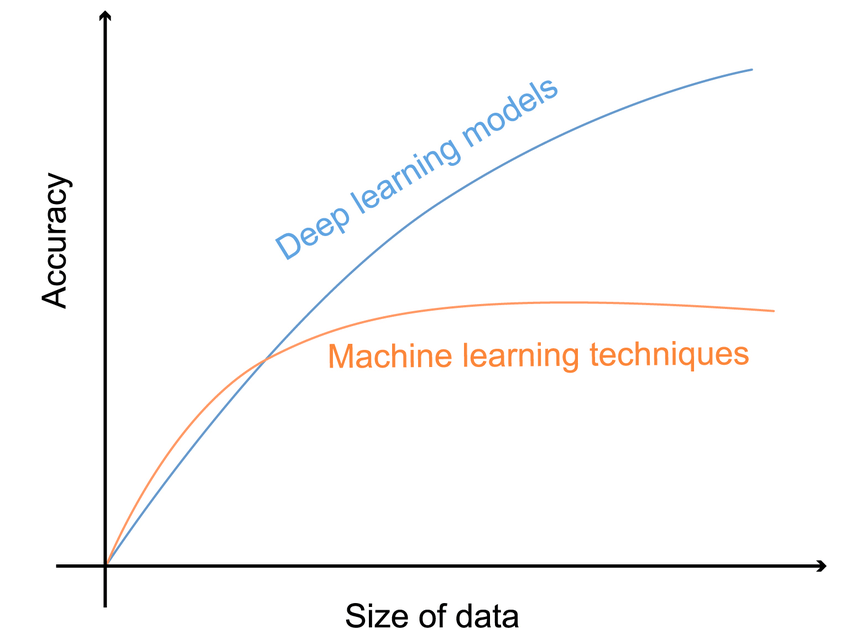
Machine Learning (ML): Traditional machine learning algorithms typically perform well even with relatively small datasets. They rely on selected features, often guided by human expertise, to make accurate predictions. For example, in a spam detection system, you might manually select features like the presence of certain words or the frequency of links.
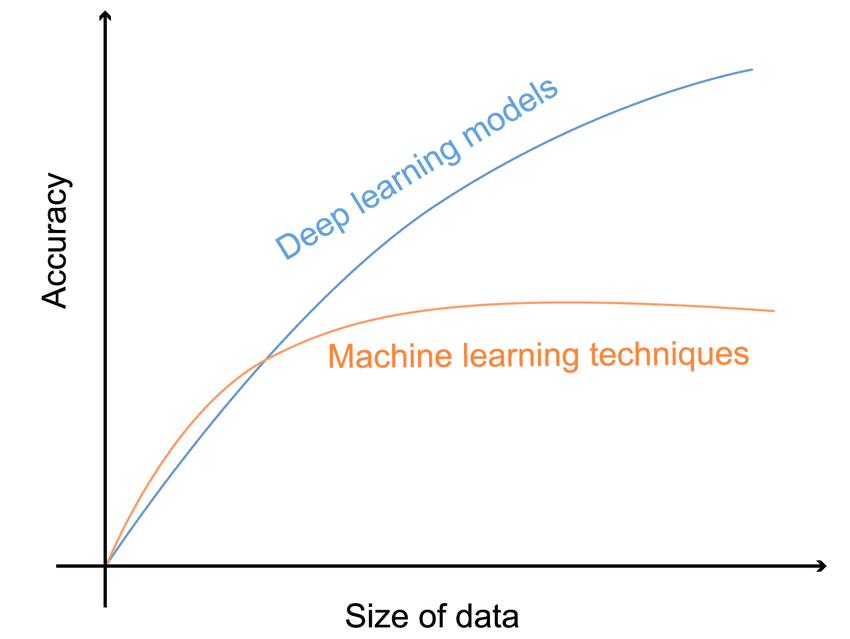
Deep Learning (DL): In contrast, deep learning models thrive on large amounts of data. The more data you provide, the better these models perform. This is because deep learning models automatically learn complex features from the data through multiple layers of neural networks. A graph of model performance against the amount of data often shows a sharp increase in performance as more data is added, illustrating the data-hungry nature of deep learning.
2. Hardware Dependency: The Need for Power
Machine Learning (ML): Machine learning models are generally less demanding when it comes to hardware. They can be trained on standard CPUs, making them accessible even on less powerful machines. For example, running a linear regression model or a decision tree typically doesn’t require high-end hardware.
Deep Learning (DL): Deep learning, however, is a different story. Due to the complex nature of neural networks, deep learning models often require specialized hardware such as GPUs (Graphics Processing Units) or TPUs (Tensor Processing Units). These hardware accelerators are crucial for handling the massive computations and large datasets that deep learning entails.
3. Training Time: Speed vs. Complexity
Machine Learning (ML): Training machine learning models is usually faster, especially for simpler algorithms like logistic regression or decision trees. These models can be trained in a matter of seconds or minutes, depending on the size of the data and the complexity of the task.
Deep Learning (DL): Deep learning models, with their many layers and parameters, often take much longer to train. Training a deep neural network can take hours, days, or even weeks, depending on the size of the dataset and the power of the hardware. The complexity of deep learning models means they require significantly more time to learn from the data.
4. Feature Selection: Manual vs. Automatic
Machine Learning (ML): Feature selection is a critical step in traditional machine learning. It involves choosing the most relevant features (or variables) to feed into the model. This often requires significant domain knowledge and manual effort. For example, in a resume-based prediction model, an expert might manually select features like education level, years of experience, or specific skills.
Deep Learning (DL): One of the strengths of deep learning is that it reduces the need for manual feature selection. Deep learning models automatically learn the features that are most relevant for the task during the training process. This capability allows them to handle raw data directly, such as images or text, and still perform well without the need for extensive preprocessing.
5. Interpretability: The Black Box Problem
Machine Learning (ML): One of the main advantages of traditional machine learning models, particularly simpler ones like decision trees, is their interpretability. You can easily trace back and understand why the model made a specific prediction. For example, in a decision tree, you can see the path the model took to arrive at a decision, making the process transparent and understandable.
Deep Learning (DL): Deep learning models, however, are often criticized for their lack of interpretability. Due to their complexity and the depth of the neural networks, it’s difficult to understand how a deep learning model arrived at a particular output. This lack of transparency is sometimes referred to as the “black box” problem. While deep learning models are powerful, this opacity can be a drawback in fields where understanding the decision-making process is crucial, such as in healthcare or finance.
Why is Deep Learning Getting So Famous?
Deep learning has become a cornerstone of modern artificial intelligence, driving innovations across numerous industries. But what exactly has fueled its meteoric rise? To understand why deep learning has become so famous, we need to explore several key factors, ranging from the explosion of data and the development of robust frameworks to the advent of specialized hardware and groundbreaking architectures. Let’s delve into each of these factors in detail, along with a touch of historical context to better appreciate the journey of deep learning.
a) Datasets: The Lifeblood of Deep Learning
Deep learning thrives on data — lots of it. The models rely on vast datasets to identify patterns and make accurate predictions. But this dependency on data didn’t always align with the availability of data.
Historical Context: Before the 2010s, data collection was relatively limited. Most machine learning models had to work with small to medium-sized datasets, and data storage was expensive. However, the smartphone revolution changed everything. As smartphones became ubiquitous, so did the creation of data. Billions of people started generating massive amounts of data through their devices, social media interactions, and cloud-based applications.
The Data Explosion: By 2015, the world was generating data at an unprecedented rate. One study noted that the amount of data being generated was doubling each year — from 2015 to 2016, the data volume grew by 2x, and by 2017, it had quadrupled. This explosion of data provided the perfect fuel for deep learning models, which could now be trained on enormous datasets, leading to better performance and more accurate predictions.
Smartphones and Pricing Revolution: Alongside data generation, the cost of storing and processing data dropped significantly. The pricing revolution, driven by cheaper and more efficient data storage solutions, made it feasible to handle large datasets, further accelerating the adoption of deep learning.
b) Frameworks: The Tools That Make It Possible
The rise of deep learning is also closely tied to the development of powerful frameworks and libraries that have simplified the process of building, training, and deploying models.
Early Days: In the early stages of machine learning, developers had to manually implement algorithms from scratch, which was both time-consuming and error-prone. The introduction of frameworks like TensorFlow and PyTorch changed this landscape by providing pre-built tools that made deep learning more accessible.
TensorFlow and PyTorch: Launched by Google in 2015, TensorFlow quickly became a popular framework due to its flexibility and scalability. PyTorch, developed by Facebook, soon followed, offering a more user-friendly approach with dynamic computation graphs, making it easier for researchers and developers to experiment with deep learning models.
DisBelief: Before TensorFlow, Google had an internal system called DistBelief, which allowed for the distributed training of deep neural networks. This system laid the groundwork for TensorFlow, showing the world that deep learning could be scaled to massive datasets.
Keras and TensorFlow 2.0: To make deep learning even more accessible, Keras was integrated as the default high-level API in TensorFlow 2.0. This combination provided the ease of use of Keras with the power and flexibility of TensorFlow, making it a go-to choice for many developers.
AutoML: The introduction of tools like AutoML has further democratized deep learning by allowing non-experts to automatically design, train, and optimize models without deep technical knowledge. This has lowered the barrier to entry, enabling a wider range of industries to adopt deep learning.
c) Architectures: The Evolution of Specialized Models
The development of specialized DL architectures has been crucial in achieving breakthroughs across different domains, from computer vision to natural language processing.
ResNet (Image Classification): Residual Networks (ResNet) were introduced in 2015 and revolutionized image classification by allowing very deep networks to be trained effectively. ResNet solved the problem of vanishing gradients, which had previously made it difficult to train deep networks. This architecture won the ImageNet competition in 2015, setting a new standard for image recognition tasks.
BERT (Natural Language Processing): Bidirectional Encoder Representations from Transformers (BERT), introduced by Google in 2018, marked a significant leap forward in NLP. BERT’s ability to understand the context of words in a sentence (by considering both the left and right context) has made it the backbone of many modern NLP applications, including search engines and voice assistants.
U-Net (Image Segmentation): U-Net was designed for biomedical image segmentation but has since been applied to various image segmentation tasks. Its architecture allows for precise localization, making it particularly useful in medical imaging where accuracy is critical.
Pix2Pix (Image Translation): Pix2Pix, a type of generative adversarial network (GAN), enables image-to-image translation. This has applications ranging from artistic style transfer to converting sketches into photorealistic images.
YOLO (Object Detection): You Only Look Once (YOLO) introduced a new approach to object detection by framing it as a single regression problem, predicting both bounding boxes and class probabilities directly from full images. YOLO’s speed and accuracy have made it a popular choice for real-time applications like video surveillance and autonomous driving.
WaveNet (Speech Generation): Developed by DeepMind, WaveNet significantly improved the quality of text-to-speech systems by generating human-like speech. Its ability to produce natural-sounding voices has been adopted in various voice-activated applications and virtual assistants.
d) Community: The Power of Collaboration
The growth of the deep learning community has played a pivotal role in its development and dissemination. As more researchers, developers, and enthusiasts have joined the field, the pace of innovation has accelerated.
Open Source and Collaboration: The open-source nature of frameworks like TensorFlow and PyTorch has fostered a vibrant community where ideas, code, and models are shared freely. Platforms like GitHub, Kaggle, and ArXiv have become hubs for collaboration, allowing people from all over the world to contribute to the advancement of deep learning.
Conferences and Competitions: Major conferences like NeurIPS, ICML, and CVPR, along with competitions like the ImageNet Challenge, have become key events where breakthroughs are presented and recognized. These gatherings bring together the brightest minds in the field, further driving innovation and adoption.
e) Hardware: The Engine Behind the Machine
The exponential growth of deep learning has been made possible by advances in hardware, particularly in processors designed specifically for the complex computations required by deep learning models.
Moore’s Law: The principle that the number of transistors on a microchip doubles approximately every two years, while the cost of computing is halved, has been a guiding force behind the increasing power of computing hardware. This has allowed deep learning models to become more complex and capable.
Specialized Hardware: The development of GPUs (Graphics Processing Units) by companies like NVIDIA revolutionized deep learning. Unlike CPUs, which are optimized for general-purpose tasks, GPUs are designed to handle the parallel processing required for deep learning. As deep learning models grew in complexity, the demand for even more specialized hardware led to the creation of TPUs (Tensor Processing Units) by Google and NPUs (Neural Processing Units) by various manufacturers.
Custom Hardware: FPGAs (Field-Programmable Gate Arrays) and ASICs (Application-Specific Integrated Circuits) have further optimized deep learning performance, allowing for more efficient training and inference. This custom hardware is now being integrated into devices from smartphones to autonomous vehicles, enabling deep learning to be deployed in real-time applications.
f) Applicability: Transforming Industries
Deep learning’s ability to solve complex problems has made it applicable across a wide range of fields, driving innovation and transforming industries.
Computer Vision: In computer vision, deep learning has enabled breakthroughs in facial recognition, object detection, and medical imaging. Applications range from security systems to diagnostic tools that can detect diseases from medical scans.
Natural Language Processing (NLP): Deep learning has revolutionized how machines understand and generate human language. From chatbots and virtual assistants to machine translation and sentiment analysis, NLP applications are now more accurate and effective than ever before.
Drug Design: In the pharmaceutical industry, deep learning is being used to predict molecular interactions and accelerate the drug discovery process. This has the potential to bring new treatments to market faster and more efficiently.
Self-Driving Cars: Autonomous vehicles rely heavily on deep learning for tasks like object detection, path planning, and decision-making. The ability to process real-time data from sensors and cameras is crucial for the safe and reliable operation of self-driving cars.
Other Fields: Beyond these well-known applications, deep learning is also being used in fields like finance (for fraud detection), agriculture (for crop monitoring), and even art (for generating new works of art)
One of the most significant milestones in DL was achieved by DeepMind’s AlphaGo, which defeated the world champion in the game of Go — a game known for its complexity and the difficulty of mastering it. AlphaGo’s success demonstrated the power of DL in tackling tasks that require strategic thinking and long-term planning.
Conclusion
Deep learning is more than just a buzzword — it’s a transformative technology that is reshaping industries and redefining what machines can do. From powering advanced AI systems to solving complex problems in fields like healthcare, finance, and transportation, deep learning has become an indispensable tool in our increasingly data-driven world.
By understanding the basics of DL, you’re not just learning about a single technique, but rather the foundation of many modern AI applications. As we continue to generate more data and develop more powerful computational tools, the impact of deep learning will only grow, leading to new innovations and opportunities.
Whether you’re a beginner just getting started or a seasoned professional looking to deepen your knowledge, staying informed about DL is key to staying ahead in the rapidly evolving field of artificial intelligence.
More in Deep Learning