Standalone/Deep Learning
Introduction to Perceptron: The First Step in Neural Networks
Sep 3, 2024·8 min read
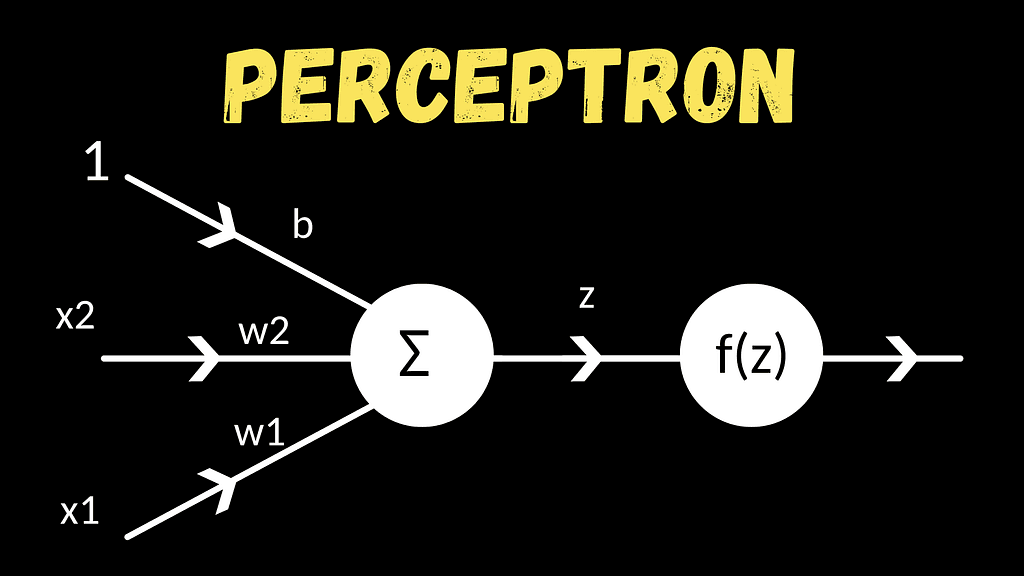
The Perceptron is a fundamental concept in neural network theory, representing the simplest form of a neural network. Developed in 1958 by Frank Rosenblatt, it is a type of artificial neuron that uses binary threshold logic to make decisions. Essentially, it’s a model of a single neuron that can learn to classify inputs into one of two categories, making it a binary linear classifier. Let’s look at it in detail to understand it properly.
Design of a Perceptron
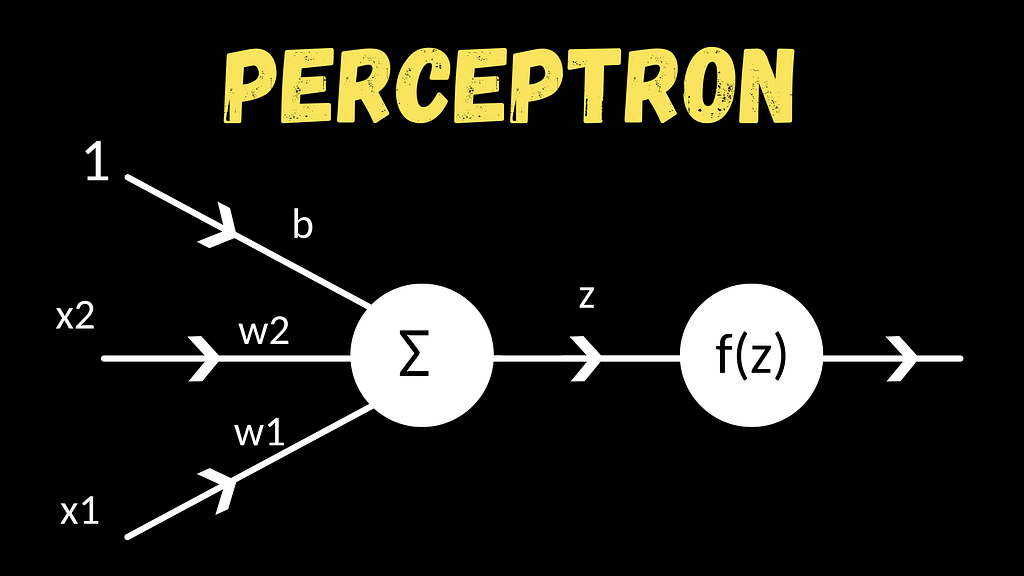
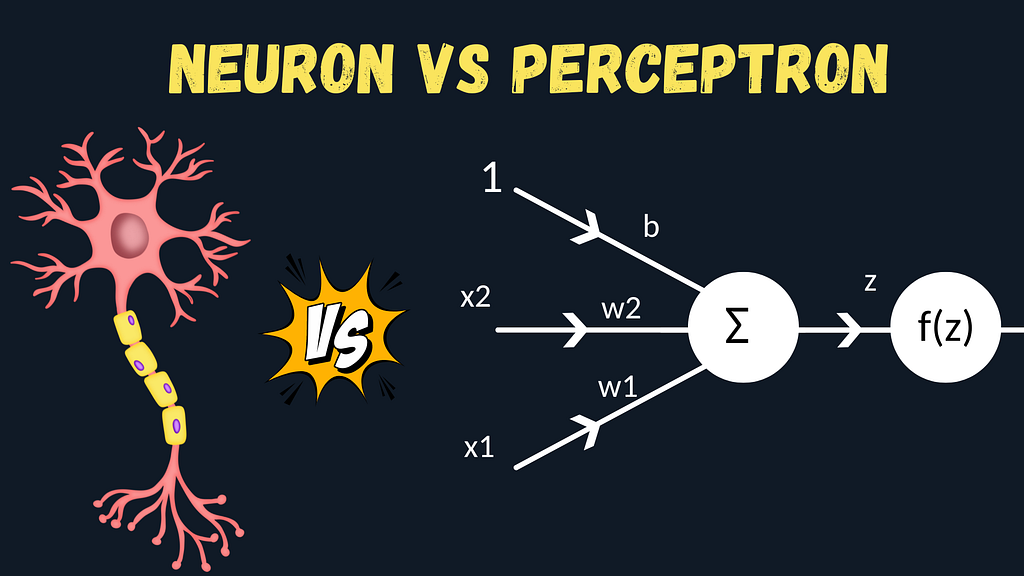
This diagram represents a Perceptron, a fundamental building block of neural networks used in machine learning to classify data into two categories. Let’s break down the parts of the diagram to understand how a Perceptron works:
1. Inputs (x1, x2): These are the pieces of data you input into the Perceptron. Each represents a different characteristic or feature of whatever you’re analyzing. For example, in a situation where you’re determining whether an email is spam or not, one input could be the presence of certain words, and another might be the sender’s email address.
2. Weights (w1, w2): These numbers indicate how important each input is considered by the Perceptron. The weights are adjusted automatically during the training phase of the Perceptron so it can learn how to make accurate predictions.
3. Bias (b): The bias is a special input that helps the Perceptron make decisions more flexibly. Think of it as an adjustment knob that shifts the decision boundary up or down.
4. Summation Function (Σ): This function adds up all the weighted inputs along with the bias. This sum determines whether the inputs, taken together, reach a certain threshold necessary for one output or another.
5. Activation Function (f(z)): This function takes the sum from the summation function and converts it into the final output of the Perceptron. Depending on the function, this could be as simple as deciding whether the total input is above or below a certain number to classify the input as one category or another.
6. Output: This is the classification result — based on the inputs, weights, and bias, the Perceptron decides which category the input data should belong to.
Working of a Perceptron
The Perceptron model works by taking multiple input signals, weighing them, and producing an output signal. Here’s how it functions step-by-step:
Inputs and Weights: The Perceptron receives inputs x1, x2, … , xn each associated with a weight w1, w2, … , wn. These weights signify the importance of the respective inputs to the output.
Summation and Activation: The Perceptron computes a weighted sum of the inputs:
z = w1*x1 + w2*x2 + … + wn*xn
This sum is then fed into an activation function. The most basic form of activation function in a Perceptron is a step function that outputs one if the sum is above a certain threshold and zero otherwise.
3) Output: The output y of the Perceptron is given by:
y= {1 if z ≥ threshold, otherwise 0}
4) Learning Rule: The Perceptron updates its weights based on the errors made in predictions. This is often done using the Perceptron learning rule, which adjusts the weights to minimize the error between the predicted and actual classifications.
Introduction to Neurons
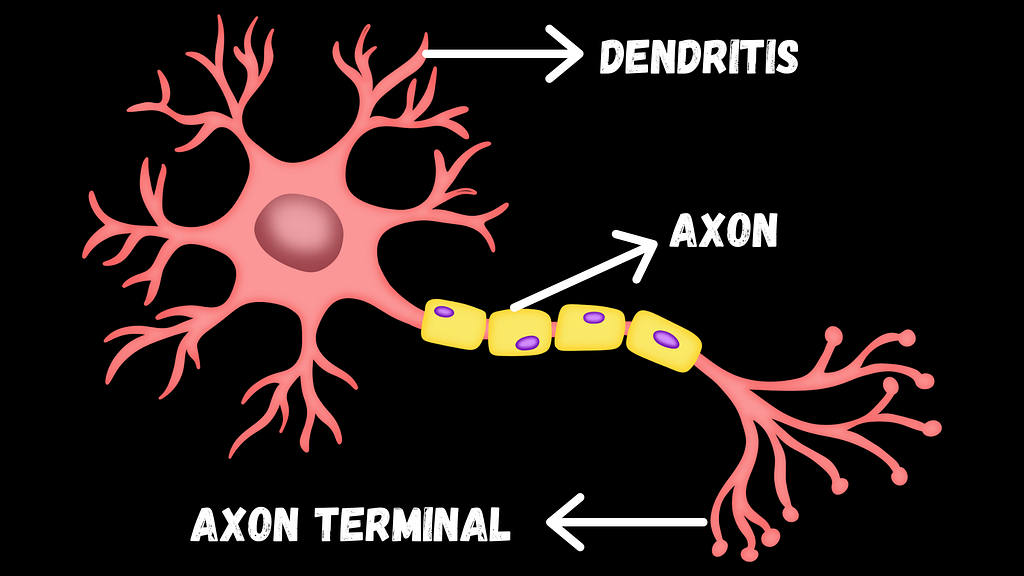
Neurons are the core components of the brain, the spinal cord, and the nervous system. They are specialized cells responsible for carrying messages throughout the body, using both electrical and chemical signals. These messages help us do everything from moving our muscles to experiencing emotions.
Structure of a Neuron
- Dendrites: These are tree-like structures that receive messages from other nerve cells and are responsible for bringing information to the neuron cell body.
- Cell Body (Soma): This is the main part of the neuron. It contains the nucleus, which houses the cell’s genetic material and manages the cell’s activities.
- Axon: This long, slender projection carries electrical impulses away from the cell body to other neurons, muscles, or glands.
- Axon Terminals: These are small branches at the end of the axon that release chemicals called neurotransmitters to communicate with other neurons at junctions called synapses.
Function
The main job of a neuron is to receive information from other neurons or sensory organs, process this information, and transmit it to other neurons, muscles, or glands in the body. This transmission occurs in the form of electrical impulses, known as action potentials, which travel along the axon to the axon terminals. At the axon terminals, neurotransmitters are released, which cross the synapse and start a similar process in the next neuron, thus continuing the communication network. Now we will look at how neurons are a big inspiration behind the idea of perception and what are the major differences between the two of these.
Neuron vs Perceptron
Similarities
Both neurons and perceptrons process information:
Signal Processing: Neurons receive signals through structures called dendrites, process these signals in the cell body, and send outputs through axons. Perceptrons receive inputs, apply some math to process them, and then produce an output.
Decision Makers: Both are built to make decisions based on the information they receive, though the complexity of their decisions varies significantly.
Differences
1. Complexity of Operations:
(i) Neurons: Neurons operate through complex electrochemical reactions, involving neurotransmitters and ion channels to create electrical signals. This complexity allows them to perform sophisticated processing and adapt to a wide range of situations.
(ii) Perceptrons: Perceptrons function through basic mathematical operations — they calculate a weighted sum of the inputs and use a simple function to produce an output. This lacks the dynamic, adaptive processes of neurons.
2. Learning and Adaptability:
(i) Neuroplasticity in Neurons: Neurons can change their connection strength based on the frequency and nature of signals, a capability that supports learning and memory in biological organisms.
(ii) Weight Adjustment in Perceptrons: Perceptrons adjust their input weights based on a set formula to minimize errors in their output, which is a straightforward but rigid method compared to the flexible adjustments in neurons.
3. Output Mechanism:
(i) Neurons: Neurons can send complex signals through patterns of pulses, which can convey detailed information.
(ii) Perceptrons: The output from a perceptron is usually a single number that results from applying a mathematical function, representing a much simpler form of communication than neuronal outputs.
4. Handling Information:
(i) Neurons: Neurons can process multiple types of information simultaneously and can integrate these in complex ways, which contributes to their ability to handle intricate tasks.
(ii) Perceptrons: Perceptrons are limited to processing inputs linearly and are not capable of the multifaceted information integration seen in neurons.
While perceptrons are inspired by the neural architecture of the brain, they are fundamentally simpler and not capable of replicating the full complexity of biological neurons. Neurons manage detailed and complex cognitive functions thanks to their advanced biochemical mechanisms. In contrast, perceptrons operate using straightforward mathematical rules, suitable for basic tasks but far from the depth of neuronal processing. In our next posts, we’ll explore advanced neural networks that attempt to bridge this gap, bringing artificial intelligence closer to mimicking the true capabilities of the human brain.
Understanding Weights and Bias
In the design of a Perceptron, weights, and bias play crucial roles in determining how it makes decisions:
Weights: Think of weights as the importance we give to different factors when making a decision. For example, if you’re deciding whether to wear a jacket, you might consider factors like the temperature and the chance of rain. In a Perceptron, each input (like temperature and rain probability) is given a weight that signifies its importance in the final decision-making process. Higher weights mean the factor is more influential.
Bias: The bias is like a built-in judgment or starting point in your decision-making. It’s an extra push that can sway the decision one way or another, regardless of the inputs. For example, if you naturally dislike wearing jackets, your bias is towards not wearing one, even if it’s cold or rainy. In a Perceptron, bias helps the model make more flexible decisions, adjusting the threshold at which the output switches from one category to another (like deciding to wear a jacket or not).
Here’s a simple way to see how they work together: When a Perceptron makes a decision, it multiplies each input by its weight, adds them all up, and then adds the bias. This total sum then determines the output through an activation function. If the sum is above a certain threshold (which includes the bias), the output might be “wear a jacket,” otherwise, it might be “don’t wear a jacket.”
By adjusting weights and bias during the learning process, a Perceptron becomes better at making accurate predictions, similar to how you might get better at deciding when to wear a jacket as you pay more attention to the right cues.
Geometric Interpretation of Perceptron
The perceptron is a type of linear classifier, which means it makes its classifications based on a linear combination of weights and inputs. Geometrically, this can be visualized as a decision boundary dividing the feature space into two distinct parts, each representing a different class.
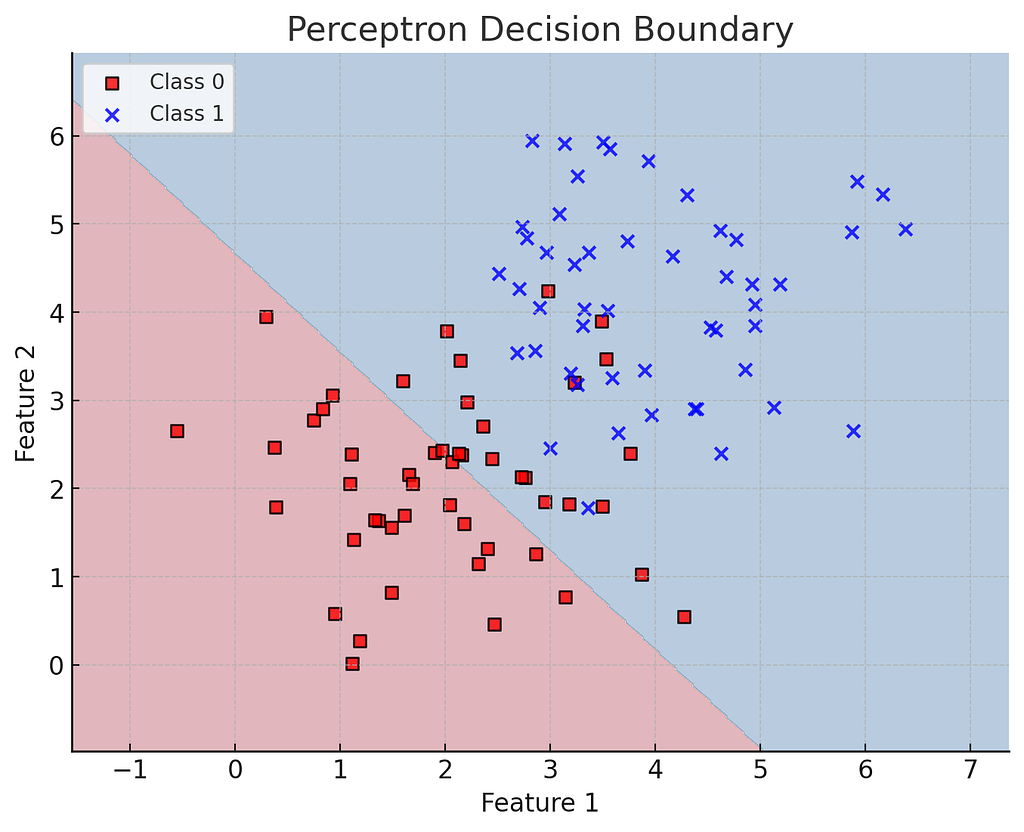
When dealing with two input features, this decision boundary is a line on a two-dimensional plane. Each side of the line corresponds to one of the classes. The equation of the line is derived from the weights assigned to these features and the bias. It can be mathematically represented as:
(w1*x1) + (w2*x2) + b = 0
Here, w1 and w2 are the weights, x1 and x2 are the input features, and b is the bias.
If there are three input features, the decision boundary becomes a plane in a three-dimensional space. The perceptron then uses these three features to determine on which side of the plane an input point lies. The equation for this plane is:
(w1*x1) + (w2*x2) + (w3*x3) + b = 0
In this equation, w3 and x3 represent the weight and value of the third feature, respectively. Points on one side of the plane are classified into one category, and points on the other side are classified into another.
This geometric approach allows the perceptron to classify data points based on where they fall relative to the decision boundary, whether it’s a line or a plane. As the number of dimensions (input features) increases, this boundary becomes a hyperplane in higher-dimensional spaces.
However, it is important to note that regardless of the number of input features and the dimensionality of the feature space, the perceptron remains a linear classifier. This means it can only classify data that is linearly separable. In cases where the data is not linearly separable, a single perceptron will not be sufficient, and more complex models or architectures, such as multi-layer networks or non-linear classifiers, may be necessary to achieve accurate classification.
Wrapping Up
In this article, we explored the perceptron, a basic building block in neural networks. We saw how it uses weights and a bias to draw lines or planes, which helps it decide how to classify different things. Though simple, the perceptron isn’t great with complicated data. Next time, we’ll dive into the “Perceptron Trick” to learn how it adjusts and gets better at making decisions. Stay tuned for that!
More in Deep Learning