Standalone/Deep Learning
The Limitations of Perceptron: Why it Struggles with XOR
Sep 3, 2024·4 min read
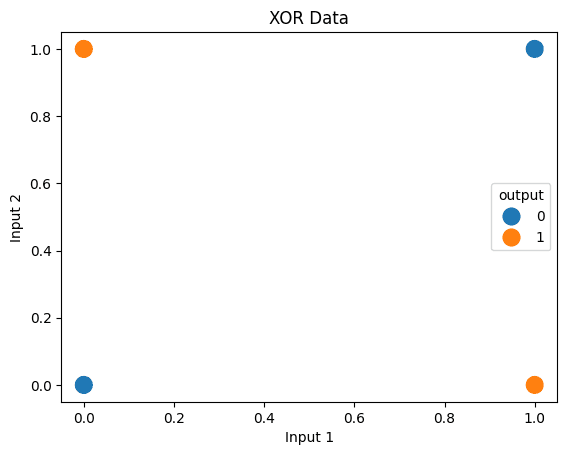
Perceptrons, introduced by Frank Rosenblatt in the late 1950s, represent one of the simplest forms of artificial neural networks. They are binary classifiers that use a linear decision boundary to classify input data into one of two categories. Despite their historical importance as the building blocks of neural networks, perceptrons have several significant limitations that have led to the development of more advanced neural network models.
This is the fourth article in our series on perceptrons, focusing on the limitations of this foundational machine-learning model. In the previous three articles, we have already talked about perceptron in detail. If you haven’t already, make sure to check out the previous articles for a solid understanding of perceptrons before exploring their limitations here.
1. Inability to Solve Non-Linearly Separable Problems
One of the most fundamental limitations of perceptrons is their inability to solve problems that are not linearly separable. A perceptron can only draw a straight line (or hyperplane in higher dimensions) to separate two classes. If the data points from different classes cannot be separated by a straight line, the perceptron fails to classify them correctly.
Example: The XOR problem, where the output is `1` only when exactly one of the inputs is `1`, is a classic case that a perceptron cannot solve because it can’t separate the classes with a straight line. In contrast, the AND and OR problems are linear and can be handled by a perceptron. Let’s explore this in detail to understand why.
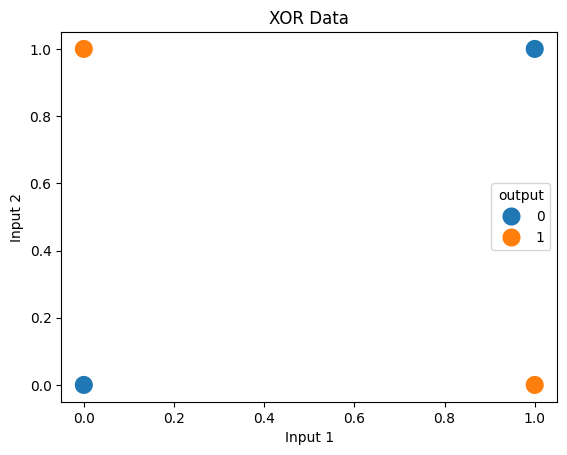
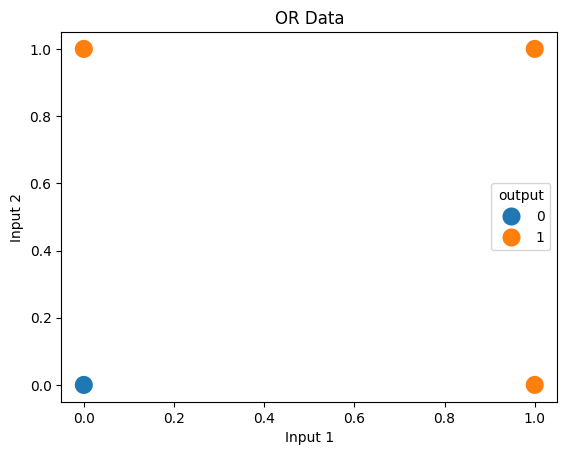
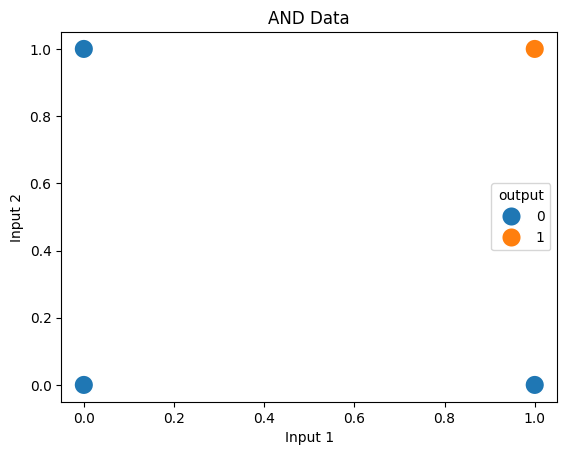
The above graphs show the distribution of AND, OR, and XOR gates. Now we will look at whether the perception can classify all these gates properly or not.
Perceptron Performance on the AND and OR Gates
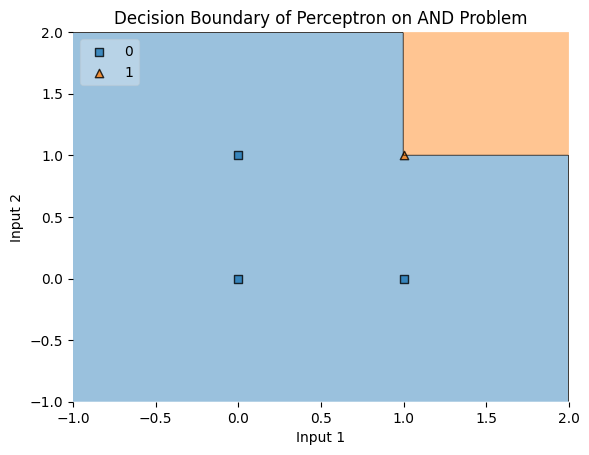
This graph shows the decision boundary created by a Perceptron model when trained on the AND logic gate problem. The boundary effectively separates the output classes, with the orange region representing the area where the model predicts 1 (when both inputs are 1), and the blue region where it predicts 0 (for all other input combinations). This demonstrates that the Perceptron successfully handles the linearly separable AND problem.
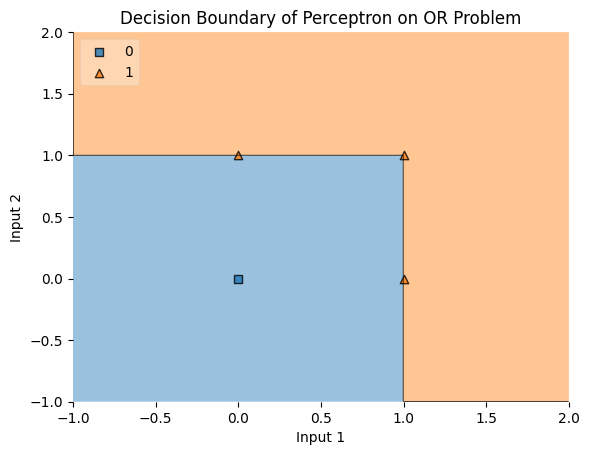
This graph shows the decision boundary created by a Perceptron model when trained on the OR logic gate problem. The boundary effectively separates the output classes, with the orange region representing the area where the model predicts 1 (when either or both inputs are 1), and the blue region where it predicts 0 (when both inputs are 0). This illustrates the Perceptron's ability to solve the linearly separable OR problem.
The XOR Problem: A Challenge for Perceptrons
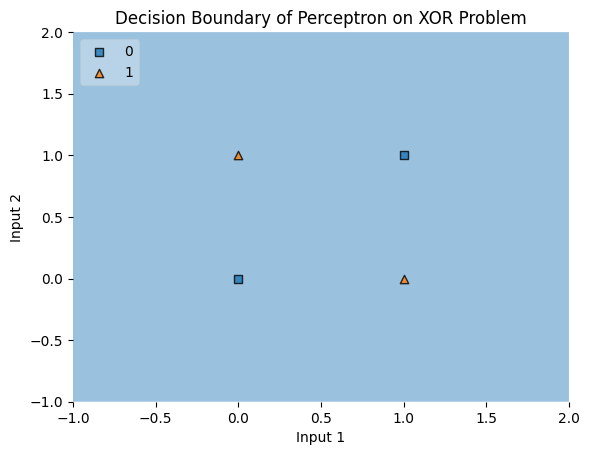
This graph shows the decision boundary created by a Perceptron model when trained on the XOR logic gate problem. The model fails to find a correct boundary, as shown by the single blue region covering all the input space. This illustrates the Perceptron’s inability to solve the XOR problem, where the classes are not linearly separable.
2. Limited Representation Power
Perceptrons can only solve problems where the classes can be separated by a straight line. They are like simple tools that can only handle problems with a clear-cut separation. If a problem needs a more complex boundary, like a curve, a perceptron won’t work well.
3. Single-Layer Structure
A perceptron has just one layer of neurons. Because of this, it can’t learn or recognize complex patterns in the data. Without extra layers, it can’t understand more detailed or abstract features, which are needed for tougher problems.
4. Sensitivity to Input Data
Perceptrons are very picky about the data they get. The data needs to be well-prepared and easy to separate with a line. If the data is messy, noisy, or not well-prepared, the perceptron won’t work well and might even fail to learn.
5. No Capability for Multi-Class Classification
A regular perceptron can only decide between two classes, like 0 or 1. To handle more than two classes, additional methods are needed, but they are not as good or efficient as more advanced models that can naturally handle many classes.
6. Convergence Issues
Perceptrons learn by adjusting their weights based on mistakes. However, this only works if the data can be easily separated by a line. If it can’t, the perceptron will keep adjusting endlessly without finding the right answer.
7. No Capacity for Memory or Time-Sequencing
Perceptrons can’t remember past inputs or deal with data that changes over time. This makes them unsuitable for tasks that require understanding sequences or context, like predicting stock prices or recognizing speech, where memory is important.
8. Inefficient Training for Large Datasets
Training a perceptron can be slow and inefficient, especially with large datasets. The training involves adjusting weights for each input, and it might take a long time to get it right, especially if the learning rate isn’t set properly.
9. No Probabilistic Interpretation
Perceptrons only give a hard decision (0 or 1) and don’t provide a confidence level or probability. This is a problem in situations where knowing how certain the prediction is can be crucial, like in medical decisions or financial forecasts.
Conclusion
Perceptrons were important in the early days of neural networks, but they have clear limitations. They can’t solve complex problems, are sensitive to input data, and can only handle simple, linear tasks. Their single-layer structure and lack of memory make them unsuitable for more advanced tasks, and they struggle with multi-class problems and large datasets. Although newer models have taken their place, understanding perceptrons helps us appreciate the progress in AI and the need for more advanced models.
More in Deep Learning